
10th August 2026
I received an early morning message from Victor. Part of it read “Dzimbadzimabwe.” This is a Shona phrase that means “houses of stone.” That’s where we were headed.
Great Zimbabwe is the remnant of an ancient African civilization, the ancestors of the Shona people. Throughout Southern Africa there are more than 500 stone walled sites like this one. This particular site once housed 20,000 some-odd people. The ancient city and its structures are so iconic that the country has taken its name and national symbols from it.


Besides being the home of thee king and his many wives, Great Zimbabwe was also a center for worship. We had a tour guide assigned to us in the park which was extraordinarily helpful and educational. We learned all about how the king had his house built in the top of the granite hill amongst the giant stones perfectly perched there, now called the Hill Complex. Below in the valley he commissioned the Great Enclosure for his first wife who was the most respected and honored of his 200 wives. From atop his compound, where his spiritual adviser also lived, religious ceremonies were performed. Totems, namely the large soapstone eagles that once graced prominent positions, were essential for protection from their god(s).


It was very interesting learning about how the Iron Age city was put together, larger granite stones broken into smaller pieces by fire and by hand and chisel, and then strategically and carefully stacked together without mortar. Designs were even carefully created into the walls of the various complexes. Only one wall of the Great Enclosure still holds an original chevron pattern, the pattern itself a symbol of feminine fertility. Symbols of fertility, protection, and power are all over the ancient city and even among the artifacts found in the place.


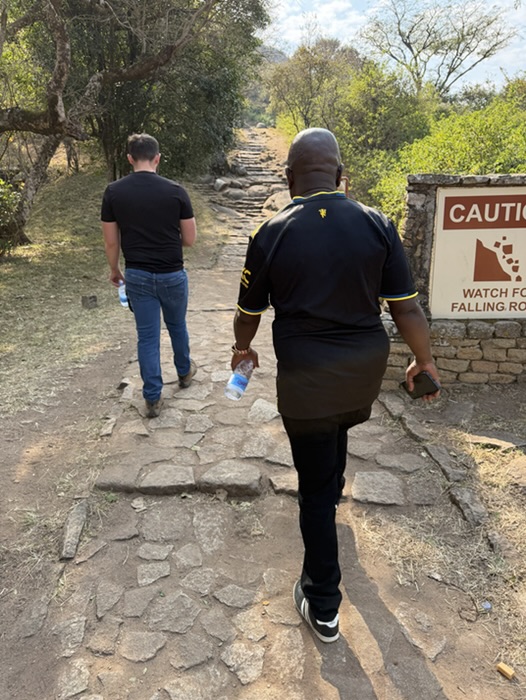
We were given the choice to either hike up the ancient path or the modern path to the top of the Hill Complex. We chose the ancient path. It was steeper and at certain points arduous, especially for three traveling pastor-types who have spent the last week sitting in chairs, eating good food talking with good people. But the ancient path was definitely more scenic. The higher we climbed the more of the valley below we could see. The valley would have been where the common folks lived, their huts open to the elements of the world rather than sheltered by stone.


The elites also lived in huts within their granite enclosures. We learned that each time a successor to the throne took power when the previous king had died (power passed from father to the firstborn son of the first wife), the king’s hut was buried and his son’s house was built on top of it. Archaeologists dug down deep enough to find 8 layers which means 8 kings reigned at Great Zimbabwe. At least that’s their best guess. Maybe there could have been a few more layers before hitting granite.


The tour guide pointed out places where soapstone birds may have been placed. She described the cavern where ceremonies were probably undertaken, as well as where a royal servant would shout, calling down to the valley to have a particular wife sent up to visit the king. Shouts from that cavern still echo back from the valley and from the enclosure below. She also described the place where rituals were performed as the king and his spiritual adviser sat and watched from the highest vantage point.


Mabasa initially feared that the hike might have been too much for him. Josh lent him a helping hand at one point. When we reached the actual compound we had a moment to rest from the climb. We had successfully navigated increasingly narrowing passages literally between a rock and a hard place. There was one extra narrow passageway that was strategic to the protection of the king. We managed it well enough.
At one point Josh and I opted to climb to the highest point and leave Mabasa just below to catch his breath. It was just the rest he needed because his energy levels rose significantly for the rest of the journey throughout the park. Josh and I, led by Patience the tour guide, climbed up and took in the view. In the opposite direction of the valley where the queens and all the little people lived, there is a beautiful view of Lake Mutirikwi. Even though it would no doubt have been slightly isolating in some ways, you get a sense of why the ancient Shona kings chose that location of prominence as their castle.


After walking around the Hill Complex a little bit more we headed down the mountain on the modern path which was constructed just after the site was declared a national monument in the late 1930’s. The path would have been easier to climb but it was shaded by trees and had almost no views of the valley. At the entrance to the modern path we saw the watergate path which was apparently a path for rainwater to be directed to a collection point below. Of course the water that the king needed would have been hauled up the hill by servants and presumably stored somewhere for daily use.
After making it all the way down we headed to the museum where we learned a little more about the way of life of the ancient Shona people, as well as some of the modern history of Great Zimbabwe. We even saw some of the iron artifacts recovered from the site by archaeologists. In the very back of the museum most of the 8 soapstone bird statues/totems are on display. There is one replica (bird #2 I believe) that is on display while the recently recovered original is somewhere being prepared for its return to the house of stones.
After the museum we walked to the Shona village that has been set up to show how people might have lived. The round structure of the huts, as well as the traditional construction materials of wood, daga (mud and clay), and thatched roofs, are still used by Zimbabweans in rural villages today. We had the chance to see some dancers perform traditional dances, and then look around and hear more about the lifestyle of the ancient Shona people.


Our tour of the valley continued, most notably with the Great Enclosure where the prominent first wife lived along with her children. She personally hosted any important visitors there. She also mentored the younger wives, making sure they were prepared to please the king. Besides the incredibly detailed construction, and the fascinating history lessons, I found the local foliage interesting. What I assumed were some kind of palm trees were actually aloe plants. Specifically they are a variety of tree aloes, some of which can reach 50 to 65 feet in height.


Along the way we periodically met up with a large family of white Zimbabweans, some of who live nearby somewhere around Masvingo. Their children were full of energy and very much comfortable in the park. It was interesting hearing some of their personal history and how their lives differ from our own. One of the ladies offered to take our picture just outside the Great Enclosure.


Having seen just about everything, and having taken hundreds of pictures of such a beautiful place, the only thing left to do was to catch a glimpse of the local wildlife in the parking lot. Apparently we had left a bag of sweet potatoes in the back of the pickup. Thankfully a security guard managed to salvage the bag of spuds from some hungry monkeys. Our legs were tired but we were somehow refreshed and ready for the long journey that was still ahead of us. I should mention that we did have coffee and not much else for breakfast, and I was starting to get a little hungry.


We jumped back in the pickup, made sure we were situated for the ride (Josh in the passenger seat ave me driving while Mabasa relaxed in the back), and headed off towards Zvishavane. We had plans to meet up with the Mkandla family who live there. Thankfully the roads were pretty good and we made good time. And thankfully it wasn’t too difficult to find Fibion Mkandla abs Gabriel (a church member from Gawa living and working in the area) in town. The real fun and adventurous part was driving on the super bouncy roads through the neighborhoods to find their house.
We had a pleasant visit, even meeting other members of the family including most of their children, a grandchild, and Fibion’s sister. We were treated to our first meal of the day (it was about 3pm) which was so appreciated. Before heading back out on the road we snapped a few family photos. Fibion and Gabriel escorted us back to the main road where we said our goodbyes.


The agreement was I would drive home from Great Zimbabwe. And I did. We left Zvishavane later than we had hoped (about 4pm) which meant we would be driving after dark. The sun sets each day just before 5:45pm. The road we would be taking was different than the one we came out on, at least as far as Shurugwi. The road is notorious for potholes, cattle, goats, and random drivers pulling out into traffic without indication. Even though he did his best to be polite about it, my driving made Mabasa a little nervous. To me it was not much different than driving in Malawi. In fact the main roads are slightly wider in Zimbabwe. There was one moment when a very large truck veered slightly into our lane and we slightly veered off the edge of broken tarmac. From that point on I did slow down a bit.
As the roads wore on, and the sun began to set, the road quality varied greatly. The roads up the mountain in scenic Shurugwi were definitely some of the worst from both a driver and passenger standpoint. When darkness truly hit, and we were driving through a very busy city (either Kwekwe or Gweru?) on a holiday weekend, I asked the guys if they would like a cup of coffee (really asking if Josh, sitting in the backseat, wouldn’t mind making me a cup). He obliged and poured Mabasa and me each a cup. He then poured himself one, and thanks to the extremely bumpy roads ended up wearing most of his coffee for the next few hours. Poor Josh.
All-in-all we had an uneventful drive home to Kadoma. Being stuck in the same vehicle for hours at a time gave us a chance to laugh together, to discuss life, and to give Josh some unique training sessions. We arrived home just before 9pm having survived the gauntlet of rough roads, impatient drivers, and hot coffee.
-Lewis VanAusdle

Leave a Reply