
2nd February 2026
… 8:00am …
We departed for Lilongwe to pick up Ruth at Zebra Market in Area 49. This being a work day we encountered some moderate traffic especially going through the city. Zebra is usually quite busy with people coming and going constantly, especially during the morning commute. Ruth was there at a major intersection waiting for us.
Along the way I had a chance to observe the roads, the people, the structures both new and old. Lilongwe is growing in many ways. The previous president built roads, some of which were completed while others sit unfinished. Their progress was halted during elections and everyone hoped that the incoming president would pick the construction back up. That hasn’t happened. There are also some housing developments that were started back in 2017 (maybe 2016). The houses look like they would belong in any housing development in the suburbs in the Midwest. They are in contrast to the locally designed and built homes, having been built by Chinese developers who negotiated the land and the construction rights with another previous president who had a questionable term.


… 10:00am …
Just a short drive up the road we met Chifundo at the Kanengo Puma filling station. We decided that he could catch a ride with us to Salima where he could more easily get back to Nkhotakota where he is living. It’s interesting that the price of fuel doesn’t change between filling stations. The price is set. So how do these stations and companies compete with one another in Malawi? It seems that more of them are including more substantial shops to help draw in customers. I’m sure location also has a lot to do with it. That and making sure the fuel shipments arrive regularly.

To give you an idea of the price of fuel: 1 liter of petrol is priced at MK4,965 which is currently $2.85. Cephas’s Mark X can hold about 70 liters (about 15 gallons). The other day we paid MK250,000 which should buy about 50 liters. That’s just under $145 for only filling the tank to 70% capacity. A full tank would cost about $200. In recent months in Brooklyn the fuel prices have been hovering around $3 per gallon. I’ve definitely filled my tank for less than $2.85 per gallon. Since there are 3.785 liters per gallon Malawians are paying about 3.785 times as much as I pay for fuel. Sometimes after traveling I complain much less about the price of gas (gasoline) in my neighborhood.
With Ruth and Chifundo onboard, Cephas still driving, we left the city and headed for Dowa. Dowa is filled with farms, set near or on some beautiful hills. The road between Lilongwe and Dowa has fewer potholes than many of the roads around the country. Probably because it’s less traveled than most. I do wish, however, that the last leg of the road to Haiton’s place was paved. It can get rough especially when driving a sedan such as the Mark X.


… 11:00am …
We drove past what you might call a driveway. I think we all were trying to remember what it looked like. We called Haiton, and while on the phone I remembered that I had once marked the location of his place on my map. Sure enough we drove right past it, creeping along the unpaved sometimes rocky hills of Dowa. We turned around and headed back the other direction. Soon enough we saw Haiton next to the road waiting for us.


I always remember the first time I visited his place there in Dowa. I was driving the Bongo and we were dropping him off after a visit somewhere. It was well past dark and it was the rainy season. The path was surrounded by encroaching maize fields. We made it down the narrow winding driveway successfully but got kind of stuck in the mud making our way out again. Definitely unforgettable. From that day forward I took that Bongo to many places where no Bongo should go.
We stopped long enough to say hello and goodbye to Sophie, see the grounds a little, and use the facilities. The previous day I think I let myself get somewhat dehydrated since we were sitting all day in one spot. Today I was determined not to let that happen which meant a few more pit stops. Haiton had heard about some of the conditions of the roads ahead of us in Salima so he opted to use his Hilux rather than the Mark X. Knowing the distances we might cover he also opted for me being the driver. I should have anticipated that but I guess I hadn’t. I had to mentally prepare myself to drive on the opposite side of the road, and to drive a manual shift pickup with the indicator switch on the opposite side than I’m used to, and the button for the horn not in its original location.
We filled up with diesel (which is MK20 cheaper than petrol — a very insignificant difference to the consumer). Haiton at least drove from his house to the filling station. But the tarmac road would be mine to cover as we departed Dowa. Thankfully the road between Dowa and the-road-to-Salima is very well paved, also not as well traveled by Malawians going from place to place. It was just like riding a bicycle. I was back in action again!
… 11:45am …
Knowing that we would have a long day, Patricia had packed us some snacks for the roadtrip which included hot water for making coffee. Partway down the road when we found a pleasant place to stop, we cracked open the picnic basket and had lunch. Little did we know that this was merely our first lunch. It wasn’t too hot just outside of Dowa so I didn’t mind standing in the sun to get some extra vitamin D. Soon it was time to get back on the road. We still had some km to cover before arriving in Salima.


… 1:00pm …
It took us just over an hour to get to Salima. The road from the Dowa turnoff to Salima has some smooth parts. No major potholes but plenty of unkept rough patches along the tarmac. We got into town and then proceeded to find Nester Phiri’s home. Her house sits just above the railroad tracks that run through town along a strait stretch. To get there you have to be willing to traverse the unpaved roads throughout Salima. Went we arrived everything looked very familiar to me. Lena and I had visited this same place back in 2017 early on in our time in Malawi.
We sat and visited, remarking how hot it is in Salima. I didn’t realize just how hot it had gotten. We enjoyed a slightly more substantial second lunch which included fish. Salima is close to Lake Malawi so there is plenty of fish to eat. We were all very grateful for the meal Nester had prepared, and also very grateful for the water bottles she picked out of the freezer.


With a now fully packed cab we headed down the road. Back on the tarmac we picked up Abel Nhlema next to a filling station. He hopped into the back of the pickup. In another part of town just on the other side of the train tracks (we crossed over at ground level) we found Abel’s father Kelvin. In 2017 I had assisted Gracious in baptizing five individuals in Blantyre. Kelvin was one of those individuals. It was an extra memorable day since it rained the whole time we were baptizing people.


Haiton hopped out of the backseat of the pickup and into the bed with Abel. Kelvin joined us inside. Away we went through the dusty seats of Salima until we came to a more rural area. We drove along roads less traveled by larger vehicles, crossing paths with bicycles and motorbikes, pedestrians and cattle. At one point we drove past an orchard of trees I didn’t recognize. I’ve seen an increasing number of macadamia trees in the country but there were bigger with larger, broader leaves. Turns out they were cashew nut trees. A once potential cash crop for the country, these trees now stand mostly abandoned by the government, now only harvested by interested locals probably only for personal use. Unfortunately I couldn’t take any pictures since I was the one driving.
As we drove on, the roads narrowed until we turned onto what could hardly be called a road. A pathway lined with mostly smaller village houses, people walking the path and having to share it with us for a moment. In certain places there was grass growing in the middle of the path. As we drove we noted how most of the maize in Salima doesn’t look too good. They’ve had quite a dry spell recently. Certain crops are resistant to periods of rain but the maize needed water it just wasn’t getting.
The ground we had covered so far, well worn paths by all sorts of foot traffic and the occasional pickup or SUV, was easy to navigate. And then the pathway became more narrow, actually more grass than path. And instead of nice soft red dusty soil, darker soil that had dried in place while it was still mud the last time it rained, filled with footprints from people and goats and dogs. Soon enough we were driving through thick grasses as high as the windows of the Hilux. I kept following Kelvin’s directions trying my best to see where a pathway might be. While the crops in the area struggle without irrigation the grasses are thriving. We did pass by a pond at one point that some people use to irrigate, but such a process is tedious and time consuming without proper equipment (which is expensive).
… 3:00pm …
Compared to the spot where we stopped to get out and walk, the town of Salima is a thriving metropolis. Parked under a tree just outside of a clearing with two small brick houses, we got out and walked the rest of the way. The neighbors greeted us as I peeked down their well to see water not far down. It’s a good sign that there is water under the surface of the ground.


We continued on, walking along semi-worn pathways along the same once-muddy soil filled with dried footprints, through the tall grass dodging grasshoppers and the occasional beach from a small tree or bush. We walked quite far until we came to a more clear path were the grass had been cut down, probably to make way for a large vehicle to pass through. We probably should have taken that pathway to start with.
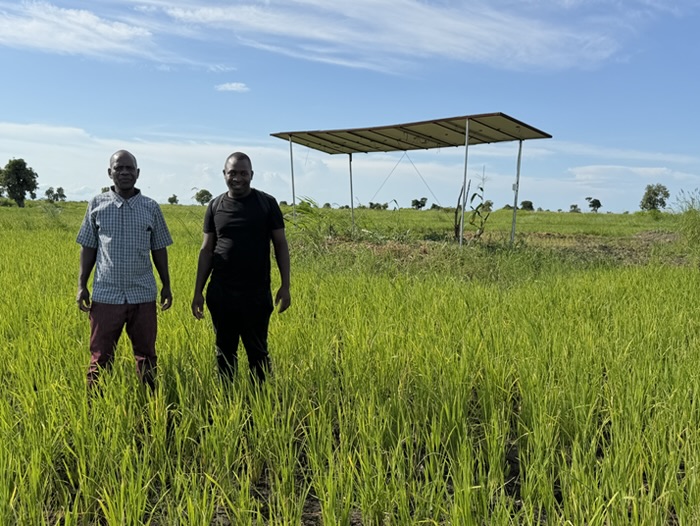
And then the grasses seemed to open up to more organized fields of rice. Kelvin and Abel showed us around the rice fields they had planted. Some sections were used as nurseries where the rice plants grow more closely together until they can be planted individually in neat orderly rows. Kevin had reached out after having purchased this plot of land and after starting to plant the fields of rice. Salima can be tricky for crops since there is water around but without regular rains crops such as rice can easily fail.


Good Works provided funds for a borehole well to be dug and a pump and solar panels installed to provide enough water to irrigate. It would appear that Kelvin’s new setup is the only one of its kind in the area. We didn’t see any other solar panels around. The original plan was to install a water tower and tank where water for irrigation could be stored. Gravity would provide the water pressure. Kelvin was able to consult with an agricultural expert who suggested digging a pond for the water instead. A small surface pump that could also be powered by the solar panels could be used. This is the option that Kelvin went for. The pond’s capacity far exceeds that of a large water tank. Plus additional ponds could be added at far corners of the rice fields making irrigation easier.
We walked out into the fields. We stood under the solar panels. We stood at the edge of the pond. Off in the distance were mountains, and somewhere out of our views was Lake Malawi. It was peaceful and quiet there. Kelvin turned on the pump and fresh, clean water poured out of the pipe straight into the pond. While irrigating with this present setup is still labor intensive, the fact that Kelvin can basically turn on a tap to water his crops is a huge benefit. The land that surrounds his fields doesn’t belong to him. But his water can be shared with his neighbors. He can also share some of his seedlings so others can grow their own rice.
… 3:45pm …
At a certain point we figured that we should start heading back to town. There was still more ground to cover. We followed the same pathways back, but this time they were more familiar. What seemed like a very long road going in, felt much shorter coming out. We did still briefly to meet the village head woman who had sold Kelvin the land. This is generally how land sales in rural areas of Malawi are done. Getting the paperwork can be a bit tricky if that’s desired.
… 5:00pm …
By dinner time we were back in town, back in the bumpy, dusty streets of Salima. We were invited inside for our fourth meal of the day … first dinner? We ate locally green and processed rice, local chicken, and nsima. The rice was aromatic and tasty. The chicken was very local (must have been a strong bird). We got a few more details about the solar project, said our goodbyes, and headed towards Nester’s house to drop her off. We grabbed a quick cup of coffee and headed down the roads, through town, back to the highway headed for Dowa.

… 7:45pm …
We arrive back in Dowa more than an hour after sunset. Far too late to have lunch with Dalles and Rachel like we had hoped. We would try again tomorrow. With all the long drives, especially bush driving, a person gets tired … and might need a cup of coffee to carry on. My coffee supply by this time is getting low. Thankfully Patricia has bought some instant coffee in anticipation of my arrival. I also have plans of finding some around town tomorrow.
We thanked Haiton and Sophie for their hospitality even though we were honestly too full to eat our second dinner upon arrival. It’s a bit disappointing when you go through all the work to prepare a meal and it just sits there getting cold. Nsima doesn’t exactly reheat well. And there aren’t too many uses for it if it goes uneaten except maybe dog food. But we would be back in the morning to explore more of Dowa.
First we had to get Ruth home. This time Cephas opted to drive. He said I could drive the Mark X the next day. Thankfully the major highways between Dowa and Lilongwe were relatively clear and relatively paved well. Since it hadn’t rained in the area the roads were clear and visibility was good.
Driving at night used to be a very dark experience. By that I mean you couldn’t see houses or even cities off in the distance since the electricity would often go out at night, planned or unplanned, for days at a time. Most of the street lights wouldn’t even work. But on this night when we reached the top of one of the hills above a portion of Lilongwe every house light was on. “It looks like a real city!” I was joking of course, but Ruth snapped back, “It IS a real city!”


… 9:15pm …
Soon we were back on the dusty, unpaved streets of that very real city, Cephas navigating the traffic, bright headlights coming at him from various directions, bicycles and motorcycles still trying to get their goods and passengers where they needed to be. Now almost three hours after sunset we dropped Ruth off in the same spot where we found her almost twelve hours earlier. She hopped a motorcycle taxi to her house and was home about fifteen minutes later. And now for the long drive back to Nkhwazi battling the potholes, crazy drivers, large trucks with bright lights, and all the cyclists and pedestrians. Thankfully the chickens and goats are asleep at late hours.
… 10:30pm …
Back in Nkhwazi we were greeted by Patricia and George, Captain and Boss (the puppies … don’t be jealous Lena), and the electricity still off. Third dinner was ready for us but we already ate plenty today. We were really taken care of. I think we are like royalty, or at least we were offered as much food. Sorry to disappoint you this time Patricia. But I’m sure there will be more food in the morning.
-Lewis VanAusdle
Leave a Reply