
21st August 2025

It was time to wake up and start moving. Neither Derek nor I had coffee in hours (since those delicious lattes in the Harare airport). Of course on such a trip as this when we have moved from place to place and had different schedules each day, our usual routines become less usual. We were looking forward to a nice hot cup of coffee and then … on the table was chocolate.
Daniel had assumed I would bring my own coffee since that has been my routine in the past. The problem was, I had shared too many cups of coffee with other people and didn’t have any more. I had also assumed that Daniel would have some on hand even though that’s not part of his typical routine. Derek and I made do, enjoying some hot cocoa instead. Can’t complain about that.

“Coffee” and breakfast with Derek and Ollie went by quickly as we prepared for our first adventure in Malawi. Our plan was to travel to the Zomba region to an area known as Mayaka. We have brethren in the area, a congregation of more than 50 people including all of the children. This would be my third trip to visit the brethren there. Gracious arrived exactly on time and we were ready to join him a little while later. We climbed in the pickup and Daniel drove down the road out of town to the north.

On my first visit to Mayaka in 2023 (accompanied by Nick Lamoureux) it was easy to see the remnants of the destructive power of the storm that had flooded the area. The homes of some of the brethren were still in shambles and new homes were beginning to be built thanks for donations from brethren. Here’s the blog post from that first visit: https://visitevery.city/2023/08/25/mayaka/

On my second visit in 2024, accompanied by my lovely wife Lena, more construction was completed. That visit gave Lena a chance to see the progress she helped coordinate with her own eyes. Here’s the link to the blog post about that visit: https://visitevery.city/2024/07/08/a-quick-dash-to-blantyre/


On this visit, rather than just checking up on already completed housing restoration projects, I was hoping to see some of the brethren I had previously met. This was also a chance for Derek to get a taste of rural life in Malawi. It’s difficult not to compare one area with another, either from country to country or from region to region. Each place has its own unique challenges even though there are similarities. While we did see some of the homes I’d seen before, and hear how the brethren who now have finished, dry places to live and good sturdy bathrooms nearby (rather than having to use unstable ones or run to the bush), it was nice to sit and chat with our brethren.

The Namatapanya family, led by deacon Mandala Namatapanya, host Sabbath services at their homestead in a shelter attached to part of their home. We ended up visiting two families on our way to the Namatapanya’s home. These two families were both helped by Good Works and LifeNets in various ways in recent years. Along the way we learned about some of the difficulties that the brethren in this area face. Some (who we didn’t have a chance to stop and see this time) live in a neighborhood (for lack of a better word) further away from where services are held. Many of them faithfully walk the long distance each week. Gracious brought up the idea of providing them with bicycles to make it easier for them to make the trip. Additionally having a bicycle would potentially make it easier for them to transport goods, to assist in providing for their families, or for general travel in the area.
Additionally we heard a story about a teenage boy who was recently dismissed from his school for requesting to take time off to keep the Feast of Tabernacles. This was a difficult school to get into which means he has good grades. There are other schools he can attend, but they are far away and it would probably take him several hours to walk there each morning. At this point in time there’s no way he or his parents could afford a vehicle of any kind, not even a bicycle. While paying a bike taxi might be an option, that also gets expensive and costs money he doesn’t have. Gracious also brought up the idea of trying to provide this young man with his own bicycle so he might continue to improve his life and that of his family as well.
There was one other story that we heard which gave us a closer look into the life of our brethren and others in a place like Mayaka. The two households we stopped and visited have to walk a long ways to fetch water. There is a borehole that is on the land of a Muslim family in the area. That family allows other families to draw water from the well because they understand that’s conditions in the area are harsh. But the families have to pay a certain fee per month for the water, and that family often ridicules their non-Muslim neighbors when they come for water. Our brethren have no other choice but to humbly endure the ridicule and pay the fee to provide water for their families. Since the two households are near each other we are going to look into having a new borehole well drilled on one of their properties so they can freely draw water without all the unnecessary hassle. Such a well would also benefit their neighbors who might also have to walk far and pay high prices for their water.

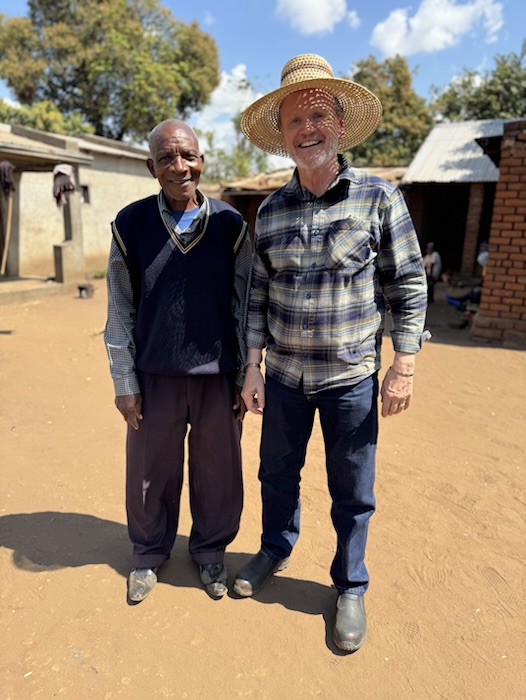
Once we reached the Namatapanya’s place, we were greeted by many of our brethren there including some familiar faces. I instantly recognized one of the Namatapanya’s sons, Geoffrey, who I see each time I visit. All of their sons definitely look alike. They have 5 sons and 1 daughter. Many of their family members make up a good portion of the congregation which is encouraging to see.

We gathered with our brethren in the shade of the three-walled church hall. The congregation is made up of many women and children. Not everyone could come to greet us but still there were nearly 30 there with us. We sat and chatted for a bit. As he had with our earlier visits, Daniel translated for us as Derek was introduced and we made ourselves available for questions and comments. There were only a few questions that came up and, in fact, one of them had been asked during a recent Bible study that Gracious had given. It was probably asked again, not to compare answers, but to have a question to ask. It was about women speaking in the Church.

There were a few inquiries about having youth camp every year and about having women’s seminars. I mentioned those are great ideas and I’d have to add them to the annual budget to make them happen. The costs for the women’s seminars or a women’s weekend would be significantly less than planning for a youth camp. The group really liked my response. They are eager to learn more and to be more involved in their Church.

We also discussed the idea of expanding their meeting hall since they are very close to outgrowing it. Added to the list of ideas is purchasing a set of plastic chairs (common in many churches all over Africa because of their price and availability). They currently have a few wooden benches to sit on and often have to borrow some from a local school to accommodate everyone.


As we were getting ready to leave after visiting with the Mayaka brethren, we spotted a makeshift bow and arrow type tool used to catch grasshoppers. Whoever it belonged to had captured quite a few already. They attached them to the front edge of the bow. And as usual, before we left, the Mayaka brethren treated us to some of their local cassava which is a rare treat for us.


We said our goodbyes to the Mayaka congregation and headed down the road with the Namatapanya’s son Geoffrey who accompanied us to our next stop. The actual trading center of Mayaka is where the area gets its name. It’s not a very well-off area but not rural. On certain days of the week there is a huge street market and an even larger marketplace in the center of town. As it is, towns often start with a small trading center where local farmers come to sell their goods. As the market grows so does the community.

Another one of the Namatapanya’s sons lives in the trading center with his family. Emmanuel and his wife have four children. Their eldest son Enoch, who I think I remember first meeting at the youth camp in 2017, is just starting his university education in Lilongwe. His sister Promise (the second born of the family) will begin secondary school also in Lilongwe. Both of them have high marks in school and are proof to some of the other youth in Mayaka and Blantyre that rural life doesn’t have to be a barrier to education and success in life.

This Namatapanya family have a some grocery store that they operate attached to the side of their house. It’s a very small shop that they sell small essentials out of. Emmanuel also has a small stand in the marketplace that he owns and uses to sell a few items in addition to some produce from his garden which is located back in the village near his parents’ home.


It wasn’t a market day when we visited so the main marketplace was almost completely empty. We only saw a few vendors selling tomatoes and dried fish. Along the main road there were quite a few shops open including tailors, popcorn vendors, phone repair shops, those selling produce along the edge of the road, and a handful of shops where guys play loud music and entice people to come buy music from them to put on their phones. The selling of music like this is a common business in Malawi. Local musicians often spread their songs this way. Geoffrey would like to get into this business in the village as there aren’t currently many (if any) such shops there. He’s restricted by the ever increasing startup cost of sound equipment, a computer, a data bundle on his phone to download songs, electricity or solar setup, and a shop to run his business out of.


We again said our goodbyes to our brethren and dropped Geoffrey off near the road so he could catch a ride home, and headed back toward Blantyre. This time we took a different route along some more rural areas with unpaved roads. Derek and I had seen many unpaved or partially paved roads on this journey so far, but I must admit that many of the roads on our return trip from Mayaka were some of the bumpiest ones for us.


As we bumped along the roads and viewed the small village homes, we discussed potential projects and also discussed life in rural Malawi. People make their own bricks to build with. They strengthen them by stacking them up, covering them in mud, and burning a very hot fire underneath them. I didn’t get any photos of such brick ovens on this trip, but I did manage to get one of a field being burned to prepare it for the next planting season. This is a common practice in many parts of Africa still, even though its benefits to the land are apparently not as good as many think they are.

Even though Derek and I slept well the night before, this was a day without coffee and it became difficult to stay awake towards the end of our journey. As we entered the outskirts of Blantyre near where Gracious and his family live, Daniel brought us to a bakery that also happens to serve coffee. It smelled amazing in there! We took a moment to sit and enjoy some lattes and cocoa with some freshly baked buns before finishing our journey back home.


Gracious headed home for the evening. The trip took a little longer than expected so he wasnt able to stick around. We had plans to see him the next day anyhow. Before dinner time, Daniel, Derek, and I decided to head to the grocery store for some coffee. I was warned by Gracious that the price of coffee had increased more than double or triple from my last visit. I drove to the store. It took a while for me to readjust to driving a manual vehicle on the opposite side of the car and the road. It also took a while to refamiliarize myself with where everything is. I definitely almost missed several turns coming and going from the store. We were successful in finding coffee in the store. It was sort of funny (at least to us) to see three men walking together in the store just getting one little jar of instant coffee.

We spent the evening eating dinner, chatting with the Ringo family, hearing Dekha call out “Daddy” and “Mommy” all throughout the house, and catching up on a few television programs including the latest Jelly episode that included some of my nephews and my friend Dave. I think we also had some evening coffee to round everything out.
-Lewis VanAusdle
Leave a Reply